Ansoff’s Matrix allows business owners to consider a number of factors that will determine their corporate strategy:
- The level of investment in existing and new products
- Exploitation of different markets
- Growth strategy of a business
- Level of risk the business is willing to take on.
It reveals 4 strategies, with the key issue being risk becomes greater the further the firm strays from its core of existing products and consumers.
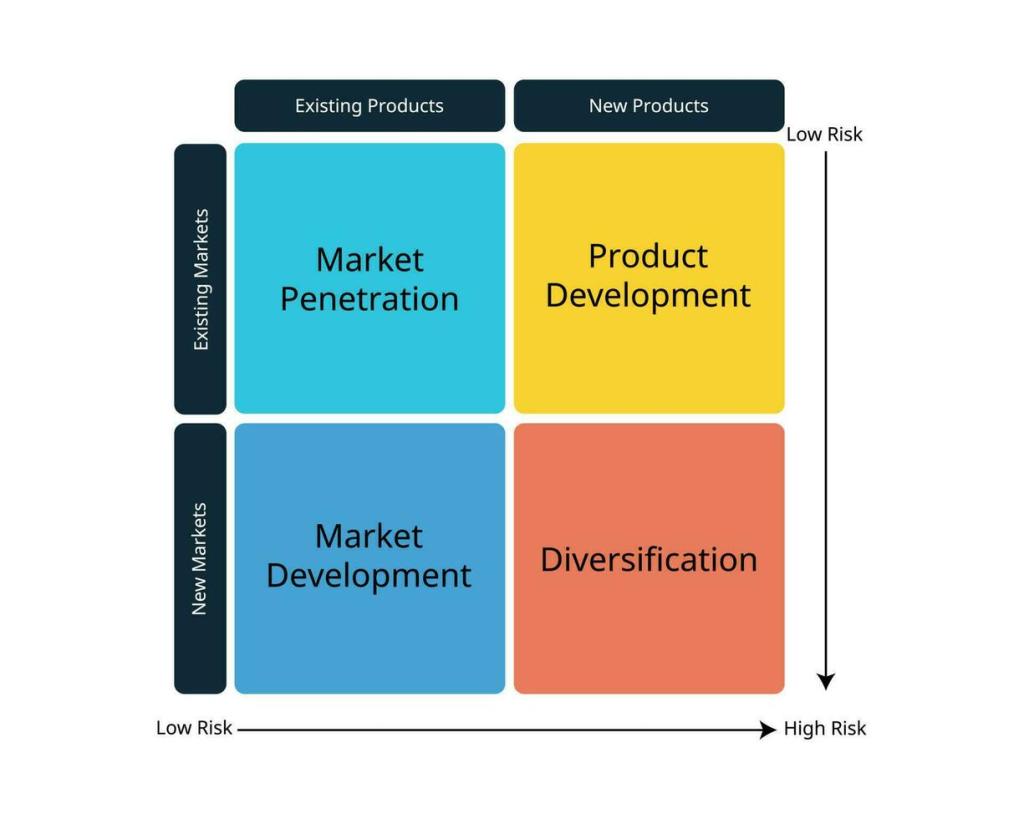
Market penetration
Market penetration is the selling existing products in existing markets. It aims to increase brand loyalty, encourage more regular use of the products, and encourage customers to use more of the product. If a business has a successful product already, market penetration is a good option. It is also the lowest risk option as it has the lowest investment and business would have a good understanding of the markets response.
Netflix didn’t reinvent its product when it first scaled. Instead, it focused on getting existing customers to watch more content. The company built an AI-driven recommendation system to keep viewers engaged, introduced the auto-play “Next Episode” function to encourage binge-watching, and invested heavily in original shows like Stranger Things and The Crown to reduce churn and create exclusivity.
Product development
Product development is where businesses sell new / modified products in existing markets they are already established in. It is an appropriate option where the life cycle of products are short, or when trends / technology change quickly. It is associated with innovation and continuous development, but requires investment into R&D and promotion.
Apple is a master of product development, and the Apple Watch is a perfect example. Apple spotted the rising trend of health and fitness wearables and developed a watch that integrated seamlessly with its existing iPhone ecosystem. The device was positioned not just as a gadget but as a health companion, with sensors for heart rate, ECG, and workout tracking. At the same time, Apple elevated the product into a lifestyle statement by collaborating with luxury fashion brands like Hermès and offering premium design options. Continuous upgrades year after year kept customers upgrading and deepened their reliance on the Apple ecosystem.
Market development
This is where marketing existing products in new markets. Most commonly used when entering geographically new markets, businesses need to pay attention to how customers in different regions / countries have different tastes / preferences. Successful development relies on understanding local habits, tastes and needs. It may be necessary to make slight modifications to suit new markets, such as different labelling or a different name in the language where the product is launched.
IKEA’s entry into India is a good case of market development, bringing existing products into a brand-new market. The company began with deep market research, learning that Indian households often had smaller, apartment-style living spaces. This led to localised product designs better suited to compact homes, while local sourcing allowed IKEA to keep prices affordable for India’s middle class. To connect with local culture, IKEA introduced Indian food options in its restaurants and launched smaller urban stores alongside its traditional large warehouses, making the brand more accessible to city dwellers.
Diversification
Diversification is the release of new products in new markets. Whilst it spreads risk and increase safety, it takes business outside its area of expertise so, hence has the highest risk on the matrix. It is usually adopted by companies with with extensive business networks, considerable capital and strong corporate brands. There may still be significant barriers to entry of new market, such as finance or industry expertise.
Virgin started with music stores, and went on to leverage its adventurous, disruptive brand identity to expand into airlines, mobile, finance, and even space tourism. Virgin used the trust it built with customers to cross into new industries and relied heavily on partnerships and licensing instead of trying to own every business outright. This flexible model allowed it to enter markets as diverse as aviation and space exploration, while maintaining a consistent brand DNA that always signalled innovation, fun, and boldness.
 The Boston Matrix
Leave a comment